
Zero-Emissions Actuation Options Expand for Remote Gas Transmission Networks
J. CARROLL, Emerson, Mansfield, Ohio (U.S.)
(P&GJ) — New U.S. Environmental Protection Agency (EPA) regulations and corporate sustainability goals are requiring natural gas transmission operators to rework existing remote valve actuators to achieve near-zero emissions limits.
Natural gas pipelines blanket the United States, with > 110,000 miles (mi) of field and gathering pipelines and > 300,000 mi of transmission lines running through virtually every state. Many of these pipelines depend on compressor stations, routing valves and pig launcher/receiver units to keep the gas moving without interruption.
Historically, these facilities have used high-pressure gas as an energy source in remote locations to actuate valves and operate equipment. Unfortunately, this results in natural gas methane (CH₄) being released with each valve stroke, contributing significantly to the CH₄ emissions being generated by the entire oil and gas industry (FIG. 1). To reduce these emissions, the EPA has passed a series of regulations (such as CFR 40 Part 60 Subpart OOOO) to address this situation,1 while other countries and regions have taken a similar approach. Regulatory compliance and corporate sustainability goals are driving the replacement of such high-emissions equipment with zero or near-zero emissions alternatives.
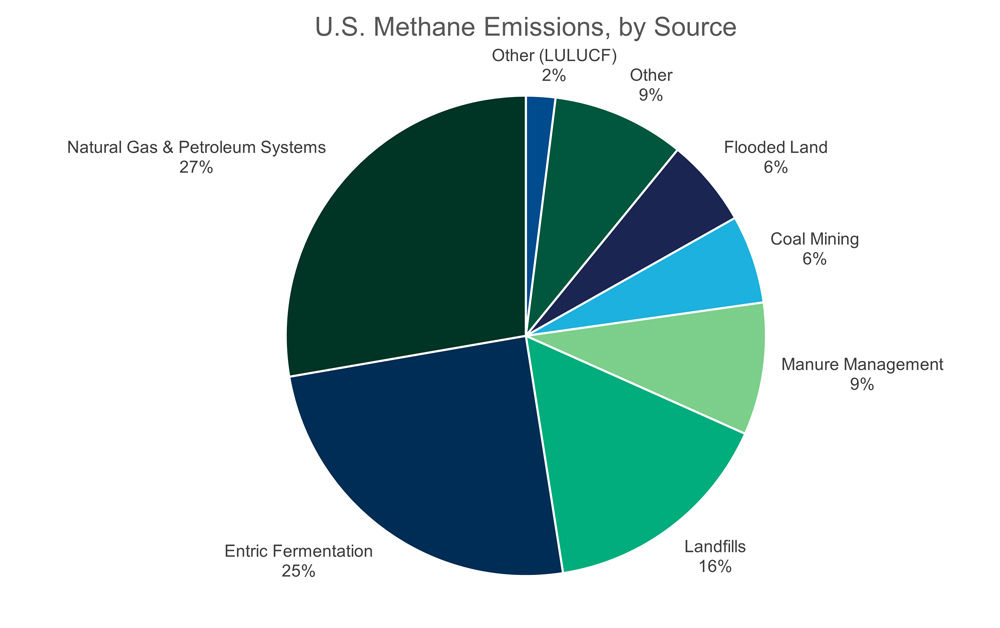
One major focus is the elimination of actuators using pressurized natural gas as a valve actuation medium.
Valve actuator alternatives. There are several ways to actuate a control or on/off valve. Many existing gas processing facilities use air-operated pneumatic actuators because the technology is mature and can be cost-effective when the quantity of valves justifies the installation cost and ongoing maintenance effort required to keep an instrument air system operating. Air-actuated valves create no CH₄ emissions; however, they tend to have limited torque so they are better suited for smaller valves. Also, the cost of maintaining a reliable source of instrument air in remote locations may be prohibitively high if the valve count is relatively low. If electricity supply is limited or non-existent, bottled air or nitrogen must be used to actuate the valves instead.
Another valve actuation option uses emissions-free electric actuators. While this technology has improved dramatically in recent years, it requires a reliable source of electricity that may not be available in remote sites. It also has actuation speed limitations and cannot usually handle high-torque applications.
A third option is electro-hydraulic actuation, where a small electric pump builds hydraulic pressure that is used to stroke the valve. This option can handle high-torque applications and typically includes an accumulator that provides enough pressurized fluid to stroke the valves once or twice, should electricity fail. This option causes zero emissions and can be solar powered provided the valves are small and do not need to operate quickly. However, larger valves and high-torque or high-speed applications will require significant electrical power, which may not be available at remote sites.
Historically, the fourth option was gas-over-oil actuators (FIG. 2). These actuators use high-pressure natural gas from the transmission line to pressurize hydraulic oil, which actuates the valve. Gas pressure is vented to the atmosphere to drop the pressure and drive the valve in the other direction.
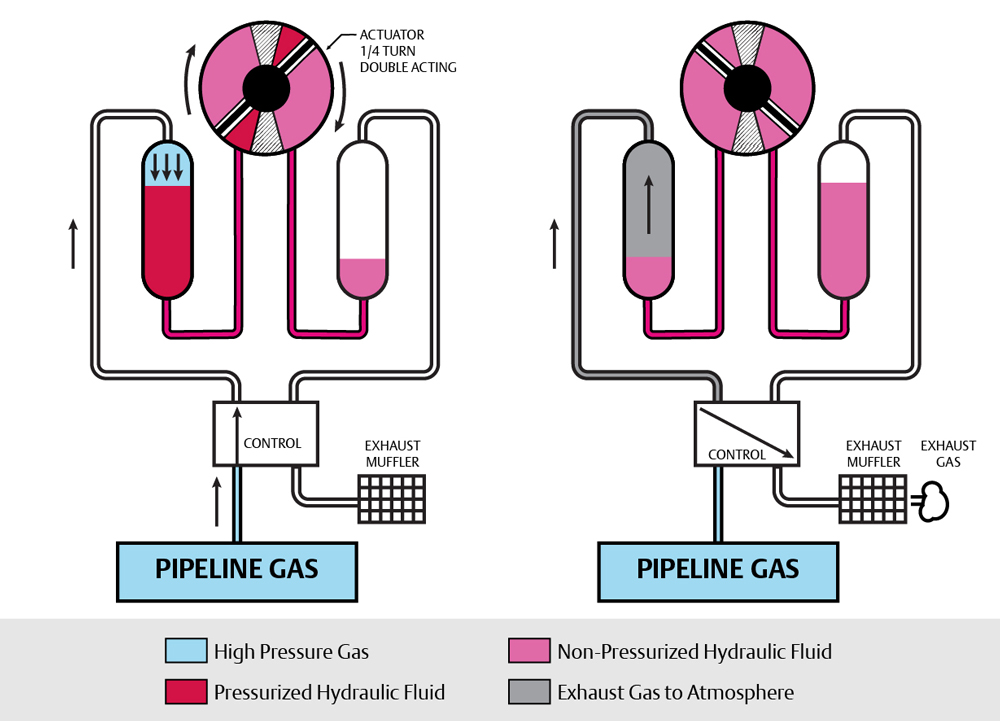
This technology has worked well because it requires no electricity to operate and can handle high-torque, high-speed applications in remote areas where electricity is unavailable. Unfortunately, this actuator type vents CH₄ with each stroke, so gas-over-oil actuators have largely been banned from future installations and must be replaced during any major upgrade.
Zero emissions gas-over-oil actuation. A zero-emissions alternative for gas-over-oil applications has been introduced: like gas-over-oil technology, it is well-suited for large valve, high-torque and/or high-speed applications. The author’s company’s emissions-controlled actuation technology (ECAT)ᵃ uses many of the same components but adds a small, low power re-injection motor (FIG. 3). High-pressure gas is used to drive the valve as before; however, after the stroke the small motor slowly drives the gas back into the pipeline, resulting in zero emissions. High-pressure gas can be routed to the other side of the actuator to reverse the valve stroke.
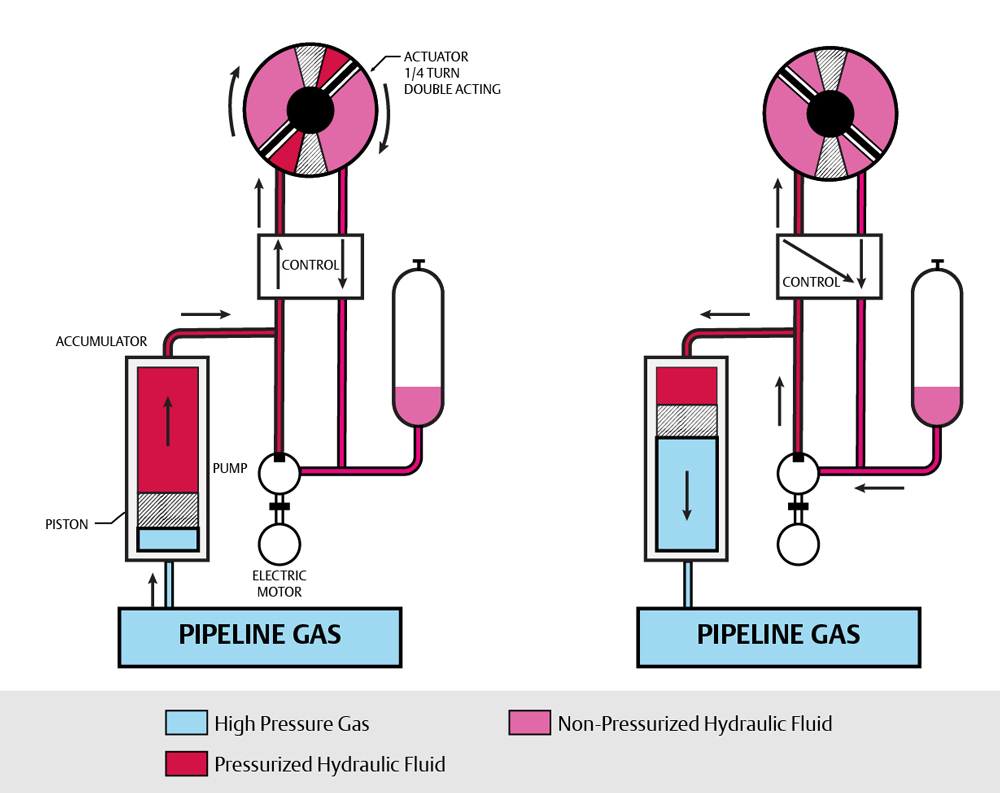
The accumulators are generously sized to allow multiple valve strokes, so the small, low-power motor has a long time to reinject the gas. The motor can be solar powered, which works well for remote sites where power is limited. The system can also include a hand-powered hydraulic pump for emergency or pressureless pipeline operation.
Another benefit of this technology is that it can be easily retrofitted to existing gas-over-oil installations, allowing a site to achieve zero-emissions goals without replacing valve actuators or even changing the valve controls. This can save significant capital costs (CAPEX) and dramatically shorten the time required to upgrade the equipment.
Multi-valve installations. Larger compression stations and/or pig launcher/receiver facilities often have multiple large valves that must be actuated. While smaller zero-emissions gas-over-oil systems can be provided for individual valves, significant CAPEX and installation savings can be achieved by installing a larger zero-emissions gas-over-oil system hub to drive a collection of hydraulically operated valves (FIG. 4).
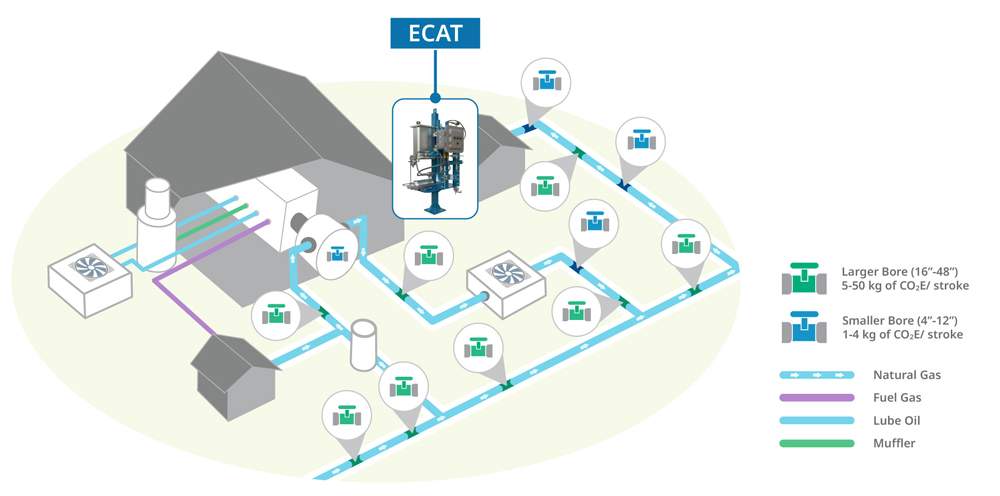
The technology is largely identical to gas-over-oil actuators, but the accumulators are much larger and sized to stroke all valves at least one or two times without reinjection. This allows the hydraulic motor to remain relatively small and requires very little power to operate. Like the individual zero-emissions gas-over-oil system, this equipment can be used to quickly and inexpensively upgrade existing gas-over-oil operations while reducing installation costs dramatically compared to replacing actuators.
Application case study. An ECAT Hub can be an excellent choice for gas compressor stations, particularly if gas-over-oil actuation is already being used onsite (FIG. 5).
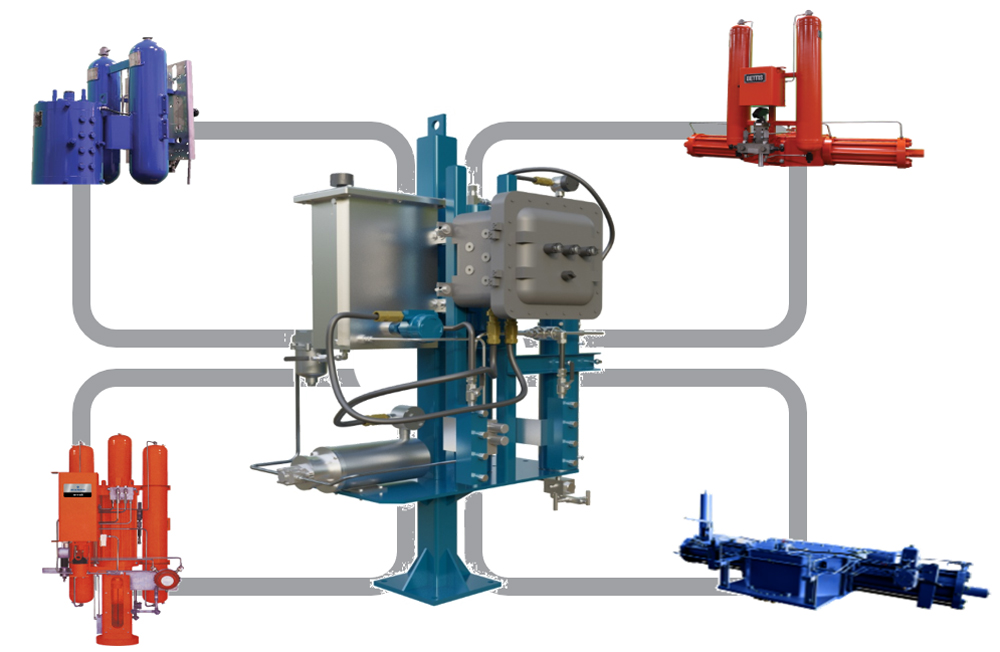
One gas compression facility used 12 gas-over-oil actuators that had to be converted for zero emissions, and conversion costs to electrical actuators were compared against an ECAT Hub installation. The ECAT Hub option offered a 70% reduction in capital installation costs, as well as a 65% savings on 10 yrs of operating expenses (OPEX). The outage time was also dramatically reduced since the existing actuators and most of the controls could remain as they were.
In addition, a smaller pig launching/receiver application had three actuators that required replacement, and an ECAT Hub and electric actuators were considered. In this case, the ECAT Hub option offered a 64% savings in CAPEX and an 80% savings on 10 yrs of OPEX.
Evaluate the options. The EPA’s OOOO regulations and corporate sustainability goals are forcing many gas transmission operators to re-evaluate their current actuator technologies and pursue very low or zero-emissions alternatives. The best choice for a given site will often depend upon the number and size of the valves, the required stroke speed, the actuator torque, the frequency of valve movement and the availability of utilities like bottled air and electricity.
However, for remote gas transmission locations where air is unavailable and electricity is very limited, zero-emissions gas-over-oil systems are well-suited for high-torque, high-speed applications with one or multiple valves. The author’s company’s ECAT technologyᵃ not only meets the requirements of the OOOO regulations, it also provides a cost-effective option for existing gas-over-oil actuators that require replacement.
NOTE
ᵃ Emerson’s Shafer™ Emissions-Controlled Actuation Technology (ECAT™)
LITERATURE CITED
1 U.S. Code of Federal Regulations (CFR) 40 Part 60 Subpart OOOO, “Standards of performance for crude oil and natural gas facilities for which construction, modification, or reconstruction commenced after August 23, 2011, and on or before September 18, 2015,” April 2026, online: https://www.ecfr.gov/current/title-40/chapter-I/subchapter-C/part-60/subpart-OOOO
ABOUT THE AUTHOR
JOHN CARROLL is the subject matter expert for pneumatics and hydraulics at Emerson. He has worked for Actuation Technologies for 14 yrs, with roles in sales, operations, and product management.