
Argentina’s Vaca Muerta Could Emerge as Major Global NGL Supplier
H. BATNIJI, OPIS, Gaithersburg, Maryland (U.S.)
(P&GJ) — Argentina's latest binding joint development agreement—signed by state-owned Yacimientos Petrolíferos Fiscales (YPF), Italian energy major Eni and XRG, the investment subsidiary of Abu Dhabi National Oil Co. (ADNOC) in February 2026—is shaping up to be a turning point in the country’s energy development, but perhaps not for the reasons many industry observers first assume. The project aims to develop the Vaca Muerta formation and export liquefied natural gas (LNG). However, what is equally interesting is the potential for the country to become a meaningful source of natural gas liquids (NGLs) for global markets. The 12-metric million tons per year (metric MMtpy) floating LNG (FLNG) facility could have the potential to recover significant volumes of ethane, propane and butane from Vaca Muerta's wet gas formations, assuming the necessary gas processing, fractionation and export infrastructures are built.
That opportunity carries important implications for petrochemical investors, midstream operators and anyone tracking global energy supply chains. This article explores Argentina’s NGL potential, the project structure and timeline, and what it might mean for Asian petrochemical markets, especially as geopolitical tensions continue to reshape trade flows. For pipeline and midstream professionals, understanding Argentina's potential entry into the global NGL market is paramount to anticipate infrastructure needs and competitive shifts throughout the next decade.
The Vaca Muerta wet gas advantage. The Vaca Muerta formation in Argentina's Neuquen province contains roughly 300 trillion cubic feet (Tft³) of recoverable shale gas and approximately 16 billion barrels (Bbbl) of recoverable oil, according to the U.S. Energy Information Administration (EIA). The wet gas areas of the formation—areas with elevated concentrations of ethane, propane, butane and condensate—have the potential to create and monetize a portfolio of hydrocarbons rather than a single commodity (FIG. 1).
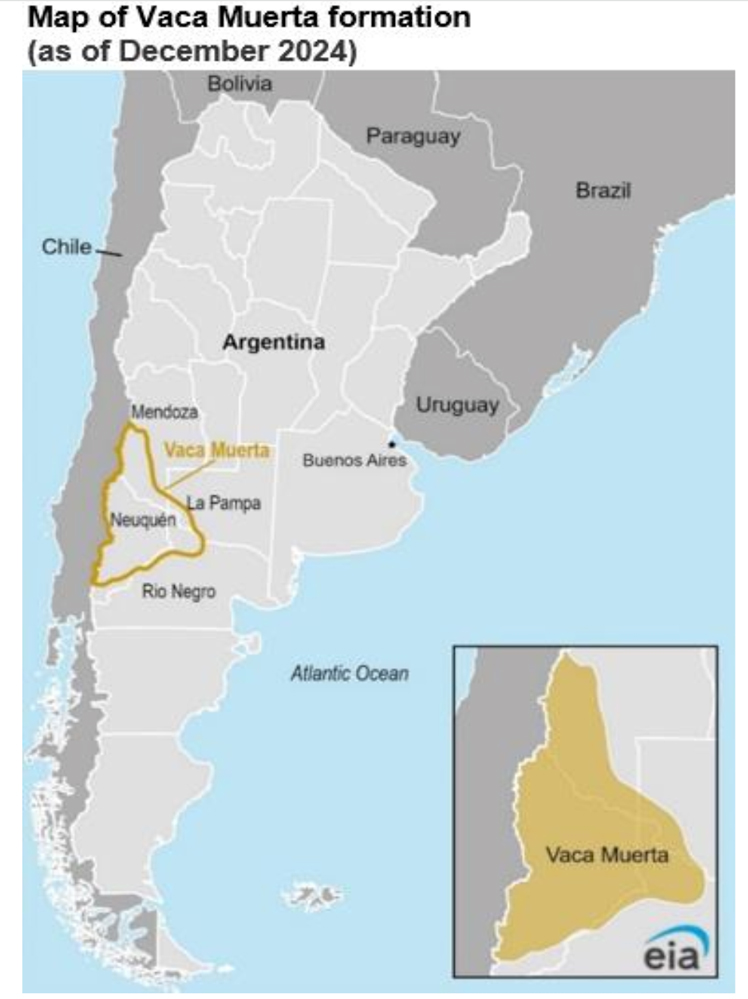
Argentina's energy output has accelerated in recent years, with oil production reaching 738,000 barrels per day (bpd) by September 2024, up 15% year-over-year and the country’s strongest monthly output since 2003. Meanwhile, natural gas production averaged 5 billion cubic feet per day (Bft³d) to 5.4 Bft³d through 2024, with the formation now accounting for more than 70% of gas output and roughly 58% of oil production. Recently, YPF traded multiple blocks in Vaca Muerta with independent operator Pluspetrol, positioning itself in areas with higher liquids content. This consolidation suggests that YPF could be pursuing gas with measurable NGL content for its planned LNG project. This strategy resembles the approach used by North American operators in conventional shale plays (e.g., the Permian and Haynesville Shale) where operators produce oil, gas and NGLs from the same tract to maximize the financial returns on their investments.
NGL demand continues to rise across residential, chemical and industrial sectors. NGLs are often overlooked in energy discussions, but understanding where they come from and how they are used helps explain their economic importance. The global NGL market totals roughly 12 MMbpd, with North America as the leading producer. Understanding where individual NGLs come from matters because their end-uses differ significantly (FIG. 2).
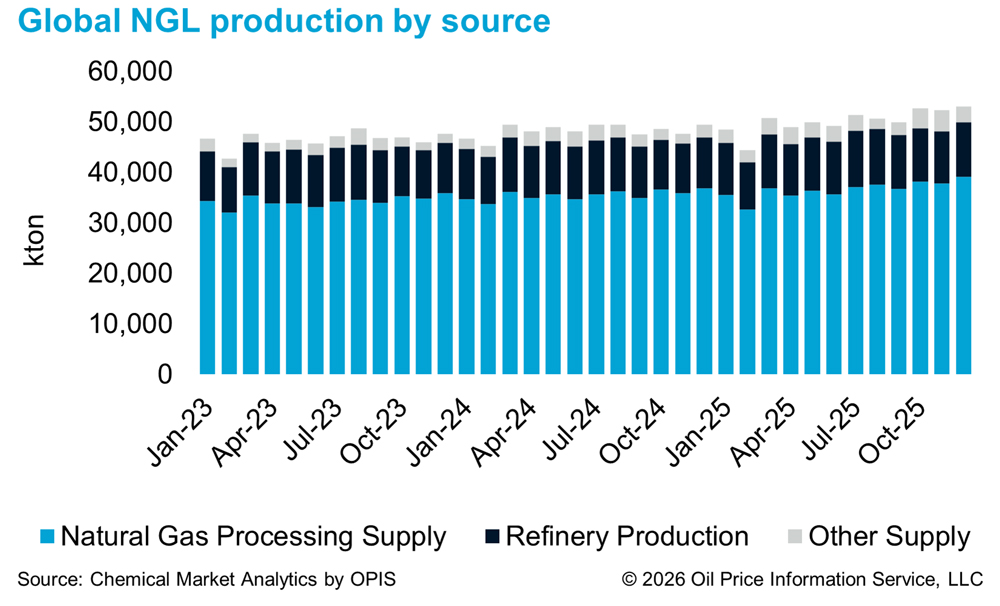
Ethane comes exclusively from natural gas processing and has one main market: petrochemical feedstock. It flows into steam crackers to produce ethylene, which is the building block for polyethylene, polypropylene and plastics.
Meanwhile, propane and butane come from both natural gas processing and crude oil refining. Propane (roughly 37% of global NGL production) caters to multiple markets: petrochemicals, residential and commercial heating, industrial uses and energy storage. Butane, including both iso and normal components, is 18%–20% of production and works as a flexible feedstock in various crackers and blends into gasoline (FIG. 3).
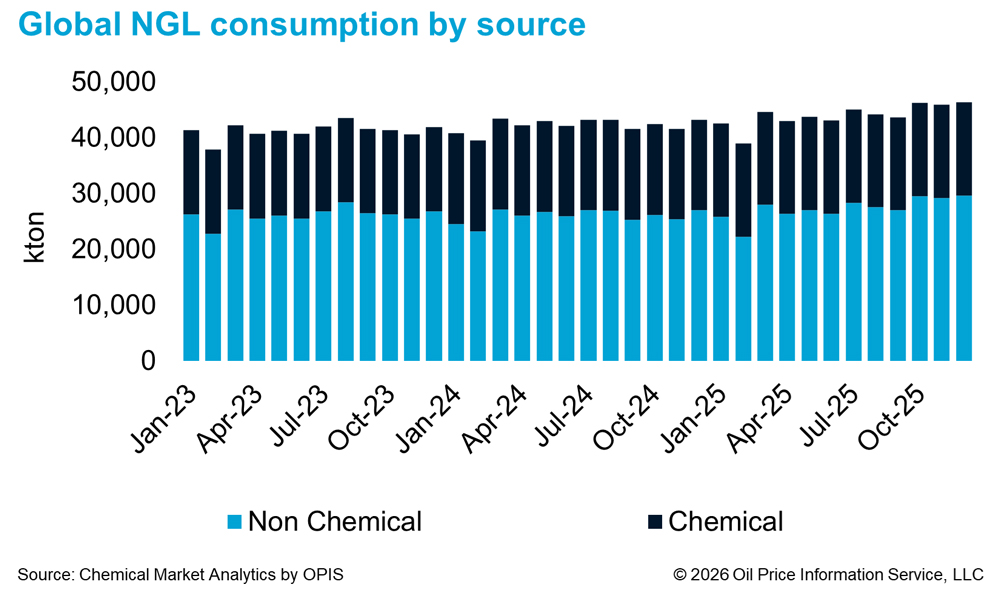
Petrochemical cracker investments shift toward flexible feedstocks and greater ethane use to safeguard tight margins. Ethane-based crackers operate with better margins than naphtha alternatives. An ethane cracker produces 75%–80% ethylene on a mass basis with minimal co-products, keeping the separation equipment straightforward. Conversely, a naphtha cracker typically yields only 30%–35% ethylene because naphtha is heavier and more complex, producing substantial co-products like propylene, butadiene and aromatics that require more equipment and higher capital expenditure (CAPEX). Ethane crackers also carry lower CAPEX. These economics have been driving Asian petrochemical investment toward ethane and liquified petroleum gas (LPG) as feedstocks.
Propane dehydrogenation (PDH), which produces propylene, presents a different picture. PDH margins have compressed significantly through 2025 and into 2026, primarily pressured by aggressive capacity overbuilding in China, volatile imported propane costs and tariffs. This structural oversupply has made the PDH environment challenging for regional operators.
Argentina's evolving NGL supply landscape. With Vaca Muerta development, Argentina's LPG production has seen growth in recent years. The country now extracts modest NGL volumes via existing infrastructure. The Bahia Blanca terminal in 2024 processed approximately 400,000 metric t of ethane (consumed domestically) and 450,000 metric t of LPG, of which roughly 50% was exported and 50% served domestic demand. LPG exports reached a record 850,000 metric t in 2024, though approximately 80% remained within the region of South America, primarily destined for Brazil. Current infrastructure constrains total NGL production to ~3 MMtpy.
The newly-announced LNG project could fundamentally change Argentina’s NGL landscape. A 12-MMtpy FLNG facility processing wet gas could potentially recover an estimated 120,000 bpd–180,000 bpd of ethane, 60,000 bpd–80,000 bpd of propane and 25,000 bpd–35,000 bpd of butane, based on standard cryogenic recovery rates applied to typical Vaca Muerta wet gas composition. Wet gas processing integrated with LNG export infrastructure could allow Argentina to capture additional value through NGL recovery. The Vaca Muerta formation's wet gas characteristics may present opportunities for future NGL development, though infrastructure requirements remain substantial.
Infrastructure and regulatory milestones. Raw gas from Vaca Muerta must be processed to separate C₂+ hydrocarbons, then transported roughly 500 kilometers (km) via dedicated NGL pipelines to Rio Negro on the Atlantic coast. The export terminal requires refrigerated storage and marine loading facilities designed for both liquid ethane (stored at –89°C) and pressurized propane and butane. The terminal would also need docking facilities for very large ethane carriers (VLECs) for ethane loading, and standard LPG carriers for propane and butane. The CAPEX for this type of infrastructure expansion is substantial.
Additionally, the global VLEC fleet could be worth watching. With new-build orders from Eastern Pacific Shipping and Asian yards adding capacity, VLEC availability could matter if Argentina begins exporting meaningful ethane volumes by 2030–2031.
Shipping routes also warrant consideration. U.S. ethane bound for Asia typically transits the Panama Canal, whereas Argentine ethane would take a longer route around Cape Horn, through the Strait of Magellan or via Suez, depending on the destination. That could add transit time and potentially increase shipping costs, which could affect how competitive Argentine ethane looks relative to U.S. supply in Asian markets. That said, the advantage of Argentine supply for Asia is geographic diversification and reduced dependence on a single supplier.
On the policy side, the country's regulatory environment has changed significantly in the past few years to support energy investment. In 2024, Argentina’s Congress passed the Bases Law, which introduced the Regimen de Incentivo para-Grandes Inversiones (RIGI)-large investment incentive regime. The RIGI provides qualifying energy projects with 30-yr tax and fiscal stability, foreign exchange guarantees and tariff certainty, creating a framework intended to attract major capital projects. The Argentina LNG project would likely qualify for RIGI protection, which addresses a historical concern for investors: policy uncertainty.
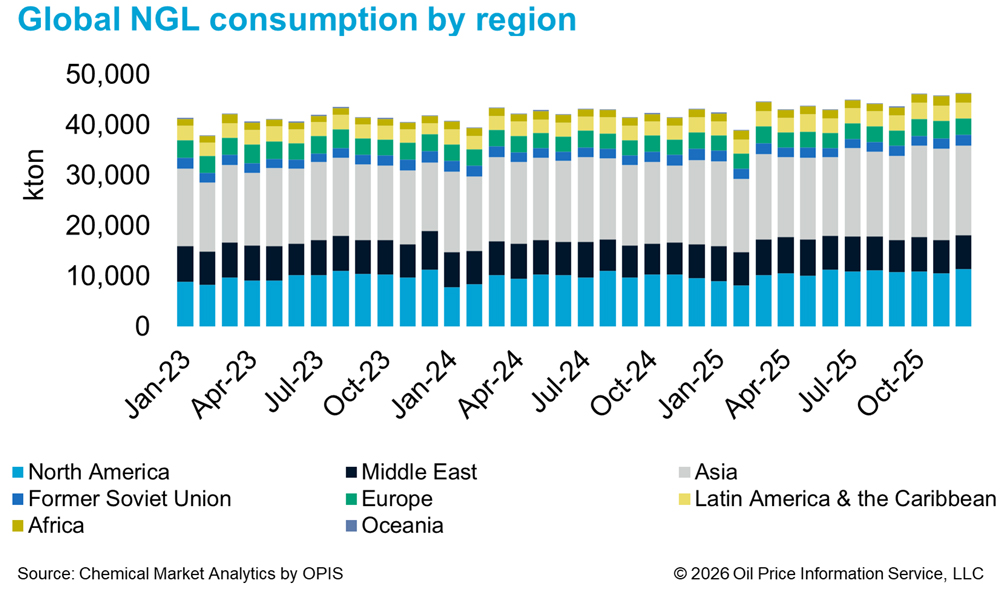
Trade implications. U.S. ethane exports averaged a record 492,000 bpd in 2024 and increased to around 580,000 bpd in 2025. Global demand for ethane as a petrochemical feedstock continues to expand, though near-term trade dynamics may influence export flows. If Argentina starts exporting ethane by 2030–2031, it could represent a meaningful addition to global intercontinental ethane supply. Asian cracker demand also continues to grow and could potentially absorb both continued U.S. supply and meaningful Argentine volumes.
U.S. propane exports reached around 1.8 MMbpd in 2025, driven by a price advantage and surging demand in Asia for petrochemical feedstocks. Argentina's potential new propane supply could compete in those same markets, particularly if the country’s supply can reach Asia at lower freight costs than routes from the U.S. Gulf Coast. Geographic diversification of propane supply could also appeal to buyers seeking supplier diversification (FIG. 4).
YPF weighs country macroeconomic and global gas pricing risks. The Argentina LNG project carries several risks worth acknowledging. Regulatory risks include potential delays in provincial permitting, gas concession negotiations or changes to fiscal terms. YPF has emphasized that long-term legal certainty is critical for project success. Argentina's track record of policy shifts creates legitimate investor concern, though current government support for major energy projects offers some near-term support.
Macroeconomic and financing risks are also a consideration, especially with the country’s past currency crises and capital control episodes. With that said, project finance will hinge on lender confidence in the government's ability to honor long-term commitments. Any deterioration in Argentina's sovereign credit profile could raise debt costs or complicate refinancing.
Commodity price risk is inherent to energy projects. If global LNG prices decline materially, or if ethane and propane spreads compress due to any issues in Asian petrochemical markets, the LNG project’s economics could suffer. Conversely, if energy security concerns intensify or Asian growth accelerates, upside scenarios are also plausible.
Execution risks include FLNG technology deployment and wet gas processing complexity. Eni and other FLNG operators have demonstrated that the technology works, but each project carries construction and operational unknowns. Project timelines could shift, and cost overruns remain possible.
Competitive risk from other LNG suppliers exists. Canada, East Africa and Australia have LNG projects in development that could come online in the 2028–2032 window, competing for capital and shipyard capacity (FIG. 5).
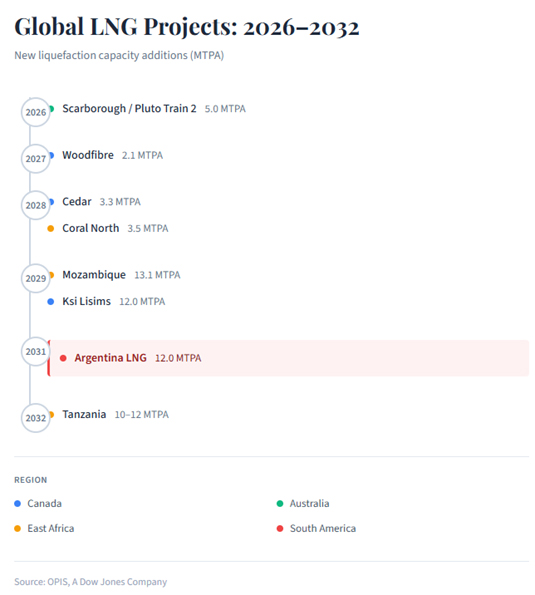
Despite these risks, several factors weigh in favor of the project’s success. Partners like Eni and XRG bring operational experience. The project benefits from regulatory support and can be financed with structures that manage commodity volatility. Additionally, the diversity of NGL products provides resilience if one market faces headwinds while others remain strong.
Takeaway. Argentina's binding joint development agreement positions the country to become a diversified NGL supplier on the global stage. Vaca Muerta's wet gas characteristics, FLNG technology and the 30-yr RIGI regulatory framework create a compelling investment case. Pending a final investment decision, the project could export approximately 12 metric MMtpy of LNG along with potentially meaningful ethane, propane and butane.
The global NGL market is mature but growing, driven by petrochemical expansion in Asia and continued propane demand for heating and industrial use. Argentina's entry as a long-distance NGL exporter could influence NGL price dynamics.
For industry professionals, the Argentina LNG project merits attention. Understanding how Argentina approaches NGL export infrastructure, regulatory structures and commercial positioning could inform strategy across emerging energy export opportunities globally. The project signifies an integrated hydrocarbon monetization model with relevance to energy-producing regions for years ahead.
About the author
HAYA BATNIJI is a Principal Analyst at OPIS, where she is part of the global team covering NGLs and naphtha markets. Her work focuses on the intersection of crude and natural gas production, feedstock economics and global petrochemical trade flows, with particular emphasis on the role of NGL supply in shaping international markets. Batniji specializes in analyzing market fundamentals, export infrastructure and the relationship between hydrocarbon resource development and petrochemical competitiveness.