

U.S. Natural Gas Storage to End Injection Season Above Five-Year Average, EIA Says
The EIA projects U.S. natural gas storage will reach 3,872 Bcf by the end of October, 2% above the five-year average. Strong early-season injections pushed inventories higher, though smaller weekly builds are expected as power demand and LNG exports rise.
(P&GJ) — The U.S. Energy Information Administration (EIA) expects natural gas storage levels to remain above average through the end of the 2025 injection season.
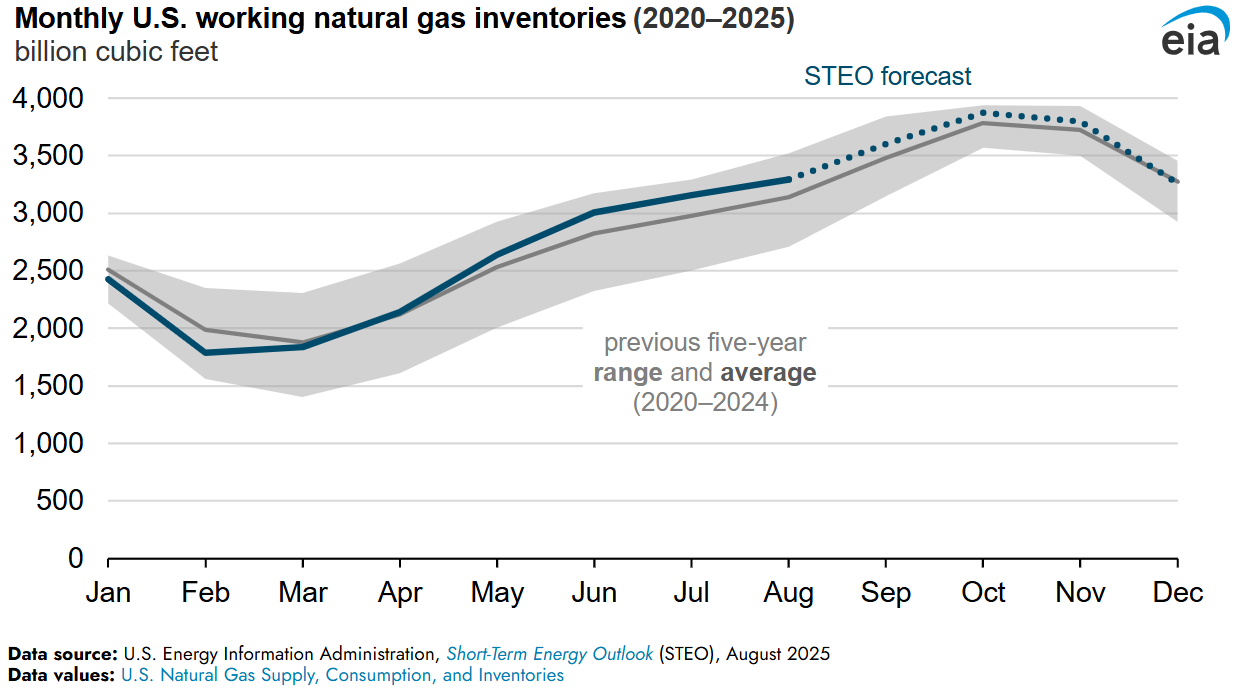
In its latest Short-Term Energy Outlook, the EIA forecasts U.S. working natural gas inventories will reach 3,872 billion cubic feet (Bcf) by the end of October, about 2% above the five-year average for that time of year.
Storage volumes rose quickly in late April through early June, when weekly net injections exceeded 100 Bcf for seven consecutive weeks — the first time that streak has occurred since 2014. Typically, such large weekly injections occur only about three times per year.
The EIA noted that U.S. natural gas production outpaced consumption at the start of the 2025 injection season, which runs from April through October. Inventories were 7% above the five-year (2020–24) average as of Aug. 8, compared with 4% below average at the end of March.
The agency expects smaller weekly injections through October as more gas is consumed for power generation and exported as LNG. Regionally, the South Central, Midwest, and East contributed most to storage increases earlier this year. The EIA projects inventories in the South Central region will finish October at their highest level since 2016, while other regions are likely to end near their five-year averages.