

Arizona-Mexico Pipeline Could Move 800 MMcf/d Across 140-Mile Route
The proposed 140-mile, 30-inch Yuma Pipeline would move up to 800 MMcf/d from Arizona to Mexico, with a federal filing planned in 2026 and service expected by 2029.
By Mary Holcomb, Digital Editor
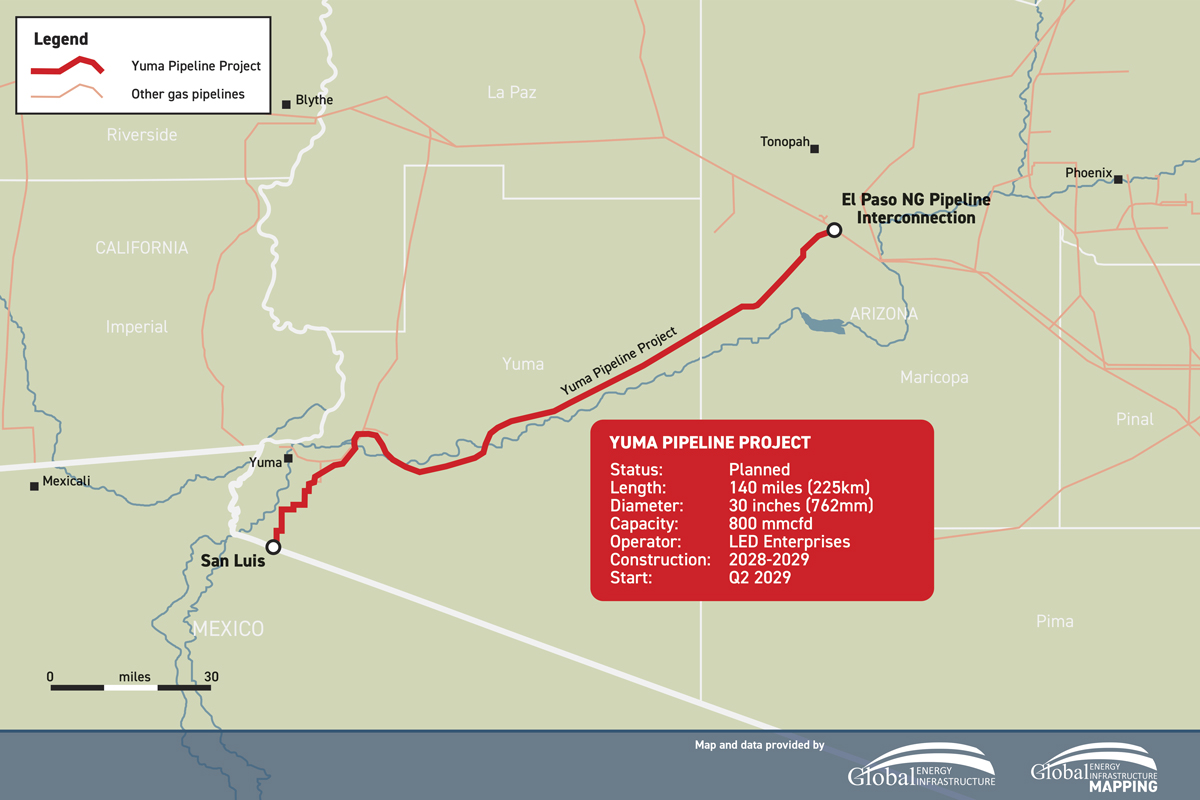
(P&GJ) — LED Enterprises, an affiliate of Grupo CLISA, is moving forward with plans for the Yuma Pipeline Project, a natural gas line designed to move up to 800 MMcf/d from Maricopa County to the U.S.-Mexico border near San Luis, Arizona.
“There’s tremendous need in Mexico for natural gas, and Arizona communities stand to benefit as well,” Andy Jacobs, senior advisor on the project, said. “Companies interested in locating or expanding in San Luis and Yuma can’t move forward because there isn’t enough natural gas or power to support them.”
According to filings with the Federal Energy Regulatory Commission (FERC), the project would serve both Arizona demand and northwestern Mexico’s growing power generation and industrial markets. The pipeline would originate at an interconnect with El Paso Natural Gas approximately 7 miles southeast of Quartzsite, Arizona, and extend southwest toward Yuma before crossing into Mexico near San Luis.
Pipeline Route and Information
For an overview of this project and other related infrastructure developments, visit Global Energy Infrastructure.
Jacobs noted that the developer is weighing two potential routes.
“There are two routes: the longer one is about 140 miles and the other one is 80 or 90 miles. We’re planning to submit both to FERC, one as the preferred and one as the alternate,” he said.
LED has said the route will be collocated with existing infrastructure for roughly 63% of its path, minimizing environmental and permitting challenges. No compressor stations are currently planned, though aboveground facilities such as pig launchers and valve assemblies will be required.
“It’s entirely tie-ins at this point,” he noted.
FERC granted pre-filing approval in April 2025 under Docket No. PF25-8-000. Jacobs said the company is on schedule for the next step.
“We put the pre-filing request in April. The goal is to submit the full application in Q1 of 2026. We’re on track for that, but we’re still in a lot of stakeholder conversations,” he said.
As part of the pre-filing process, LED hosted open houses in Buckeye and Yuma in June, drawing more than 100 attendees, including landowners, tribal representatives, and local officials. The Cocopah Indian Tribe provided feedback on route impacts near the Gila River, and state regulators raised questions about Clean Water Act permitting.
In a September filing, LED reported outreach efforts with the Arizona Corporation Commission, utility representatives, and the Greater Yuma Economic Development Corp. The company also met with the Yuma-Mesa Irrigation District to discuss right-of-way issues and is preparing right-of-entry requests for field surveys, including coordination with the Bureau of Land Management for federal land access.
“Landowners just want to understand how it’s going to affect their property. Some don’t mind if since it’s underground, while others worry about agriculture like citrus groves,” he said, noting that feedback from stakeholders has varied. “On the other side, businesses and local leadership are almost desperate for new energy sources.”
The project has also drawn formal opposition. In a July filing, Hard Red Turtle LLC, a Yuma-based developer, objected to the proposed routing along County 13th Street between Avenues 6E and 6½E. The group said the alignment would run next to a planned 304-lot residential subdivision, raising concerns about property values, safety risks, and quality of life for future residents.
More broadly, Jacobs acknowledged the complexity of balancing competing interests. He said the project involves coordination with multiple stakeholders, from railroads and ADOT to proving grounds and agriculture, which adds to the challenge and can slow timelines as different government entities weigh in.
Earlier this year, LED filed draft Resource Reports 1 and 10, which detail the project’s purpose and environmental considerations. FERC staff provided comments in June, requesting further clarifications, and the company will revise those reports as part of its forthcoming application.
While the immediate impact will be construction jobs, Jacobs said the longer-term effects are more significant.
“San Luis has had to turn companies away because they don’t have natural gas. Long-term, this will create a lot of jobs because these communities are poised for strong growth,” he said.
Jacobs framed the project as a critical step for the state’s economy.
“Arizona’s economy is booming, but to continue that pace of growth, there simply needs to be more power. Local utilities are basically tapped out. It’s exciting to see Arizona communities and Mexico working together,” he added.
If approvals are secured, construction could begin in early 2028 with in-service expected by 2029.