

Cushing Crude Inventories Near ‘Tank Bottom’ Operating Levels, EIA Says
As Cushing crude inventories approach minimum operating levels, EIA explains how "tank bottoms" can tighten available storage and influence oil market pricing.
(P&GJ) — Crude oil inventories at the Cushing, Oklahoma, storage hub have fallen below 20 million barrels in recent weeks, prompting the U.S. Energy Information Administration (EIA) to explain how "tank bottoms" can affect storage operations and market pricing.
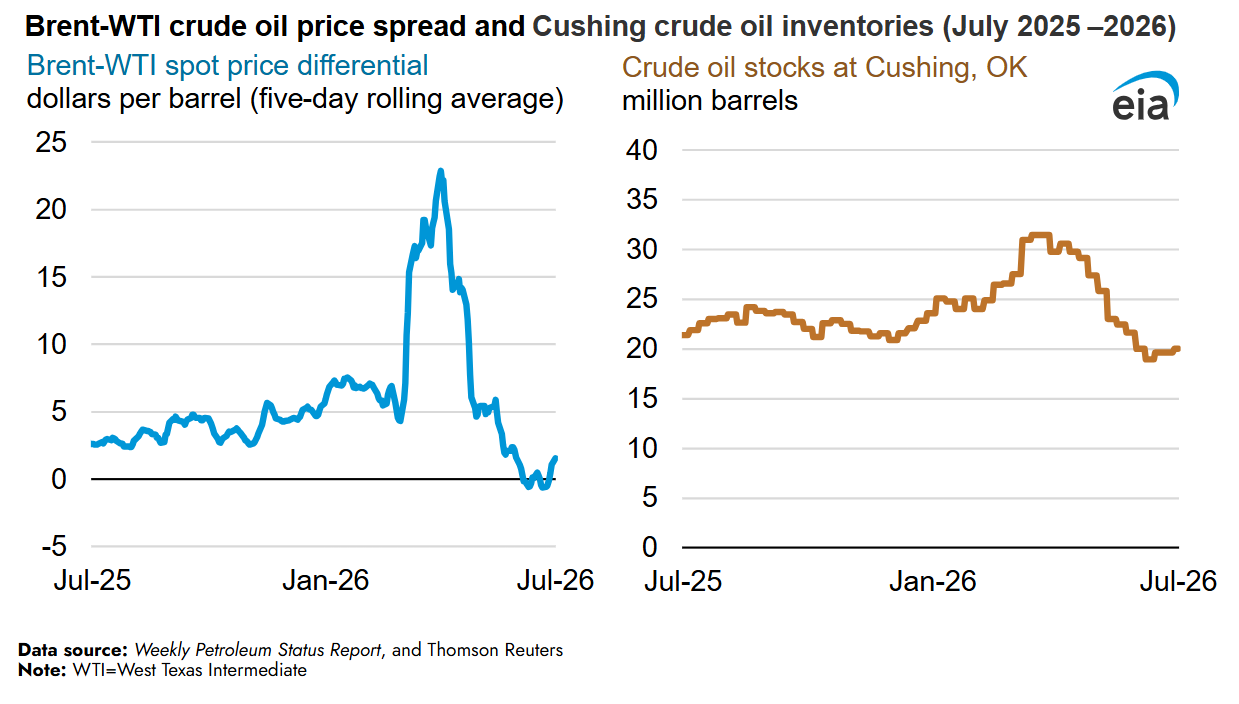
According to EIA, storage tanks require a minimum volume of crude oil to remain operational. Known as tank bottoms, this inventory allows pumps and related infrastructure to function properly. Once inventories approach these minimum operating levels, not all stored crude is readily accessible, even though tanks are not technically empty.
Tank bottoms also distinguish working storage capacity from shell capacity. While shell capacity represents a facility's total design volume, working capacity reflects the usable storage available after accounting for the minimum inventory needed to keep the system operating safely.
As Cushing inventories dipped below 20 million barrels between June 19 and July 10, the price spread between Brent crude and West Texas Intermediate (WTI) narrowed sharply, briefly turning negative. EIA said the unusually strong WTI price suggests inventories may be approaching tank-bottom levels, tightening available storage capacity and contributing to stronger regional crude prices.
EIA noted that petroleum storage facilities generally cannot draw inventories to zero because operators must maintain minimum working volumes. As a result, a facility may still contain crude oil but be unable to deliver additional supply if inventories fall to the bottom of its working storage capacity.