

Beyond Line of Sight: Pipeline Monitoring in High-Consequence and Hard-to-Access Environments
Pipeline operators are adopting new approaches to monitor high-consequence and hard-to-access corridors where traditional inspection methods face increasing operational challenges.
Pipeline monitoring has long depended on a straightforward assumption: if you need to see the corridor, you can get there. Aerial patrols can be dispatched. Ground crews can access the right-of-way. Inspections can be scheduled and executed on a predictable cadence.
For a growing number of operators, that assumption is no longer reliable across their entire network.
High-consequence areas in densely populated urban corridors introduce restrictions that complicate routine surveillance. Remote and rugged terrain limits how often ground crews can realistically reach certain sections of the right-of-way. Restricted airspace can eliminate conventional aerial options altogether in portions of the corridor. Each of these constraints creates the same core problem: sections of the pipeline that cannot be consistently observed, regardless of the program design or the resources allocated to it.
Where those monitoring gaps persist, risks accumulate. Damage prevention programs become less effective in the areas they are least equipped to cover. Safety assurance becomes harder to sustain across the full length of the network. And regulatory obligations, which assume continuous oversight, become increasingly difficult to demonstrate in the segments that are hardest to reach.
These are operational realities for pipeline operators managing infrastructure across some of North America's most complex environments, and the industry is overdue for a frank conversation about how to handle them.
On August 5, two of those operators will discuss them publicly.
TC Energy and PG&E Join the Conversation
TC Energy manages an extensive pipeline network spanning the United States and Canada, including infrastructure crossing some of the most operationally demanding terrain on the continent. Pacific Gas and Electric Company (PG&E) operates critical gas infrastructure throughout California, including corridors running through densely populated urban areas, remote landscapes, and everything in between.
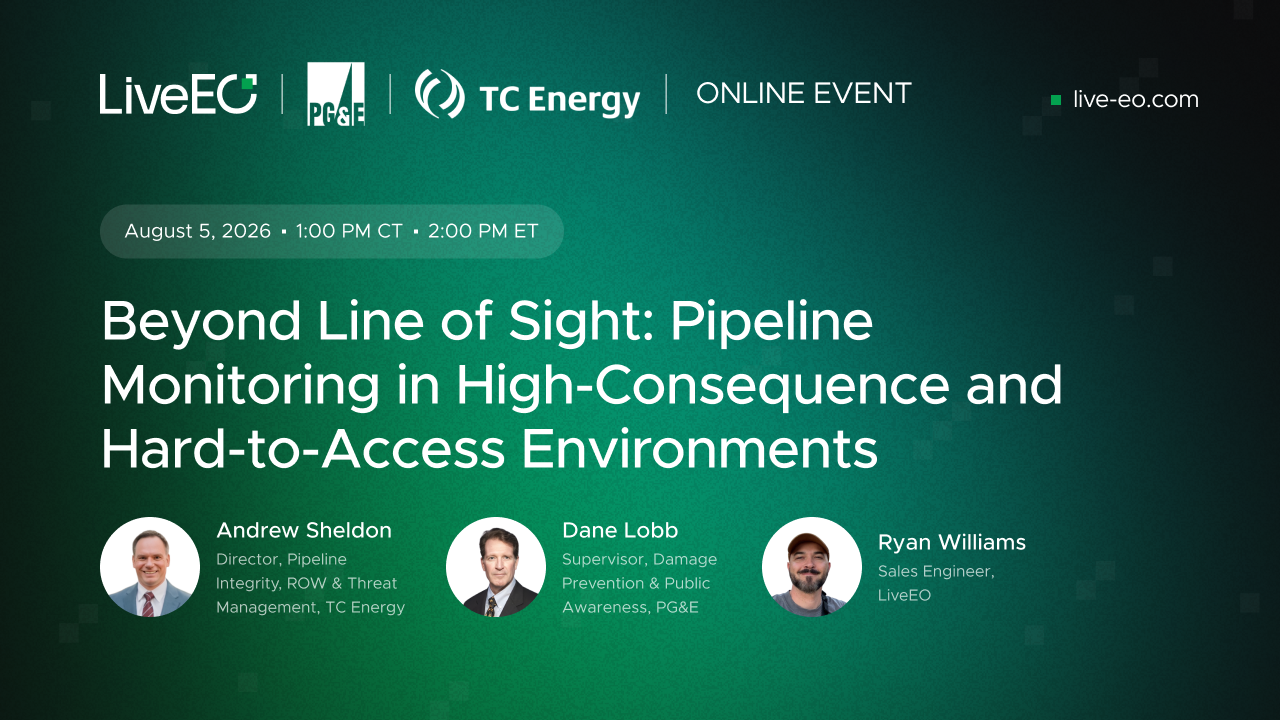
In a live virtual session hosted by LiveEO on August 5 at 1:00 PM CT, Andrew Sheldon, Director of Pipeline Integrity, ROW & Threat Management at TC Energy, and Dane Lobb, Supervisor of Damage Prevention and Public Awareness at PG&E, will share how their organizations approach this challenge in practice.
The session, Beyond Line of Sight: Pipeline Monitoring in High-Consequence and Hard-to-Access Environments, will cover the operational reality of managing monitoring constraints across a live pipeline network: not theoretical scenarios, but direct field experience from two of the industry's largest operators.
What Attendees Will Hear
The discussion will move through the full scope of the challenge, from problem to response. Sheldon and Lobb will address how different types of access constraints, dense urban corridors, restricted airspace, remote terrain, each create distinct monitoring challenges and how those challenges affect the performance of damage prevention and integrity programs.
They will also share the practical approaches their organizations have developed: how they identify where monitoring gaps exist, assess the risks they introduce, and build operational processes that maintain meaningful oversight in the absence of consistent conventional surveillance.
The session is moderated by Ryan Williams, Sales Engineer at LiveEO, which provides satellite-based right-of-way monitoring for pipeline operators managing access-constrained corridors.
Why This Matters Now
The constraints that limit conventional monitoring are not new. Restricted airspace, challenging terrain, and urban encroachment have been features of pipeline operations for decades. What is changing is the frequency with which operators are encountering them, and the pressure from regulators, landowners, and the public to demonstrate that oversight is being maintained in spite of them.
Pipeline integrity professionals, damage prevention managers, and operations teams responsible for maintaining oversight in environments where conventional methods face limits will find this session directly relevant to their work.
Beyond Line of Sight: Pipeline Monitoring in High-Consequence and Hard-to-Access Environments takes place on August 5, 2026 at 1:00 PM CT / 2:00 PM ET. Registration is open. Save your spot here.