

U.S. Natural Gas Storage Capacity Grows for Third Straight Year
U.S. underground natural gas storage capacity increased again in 2025, with most additions concentrated in key producing and transportation regions across the South Central and Mountain states.
(P&GJ) — Underground natural gas storage capacity in the Lower 48 states increased modestly in 2025, with most of the growth occurring in the South Central and Mountain regions, according to the U.S. Energy Information Administration (EIA).
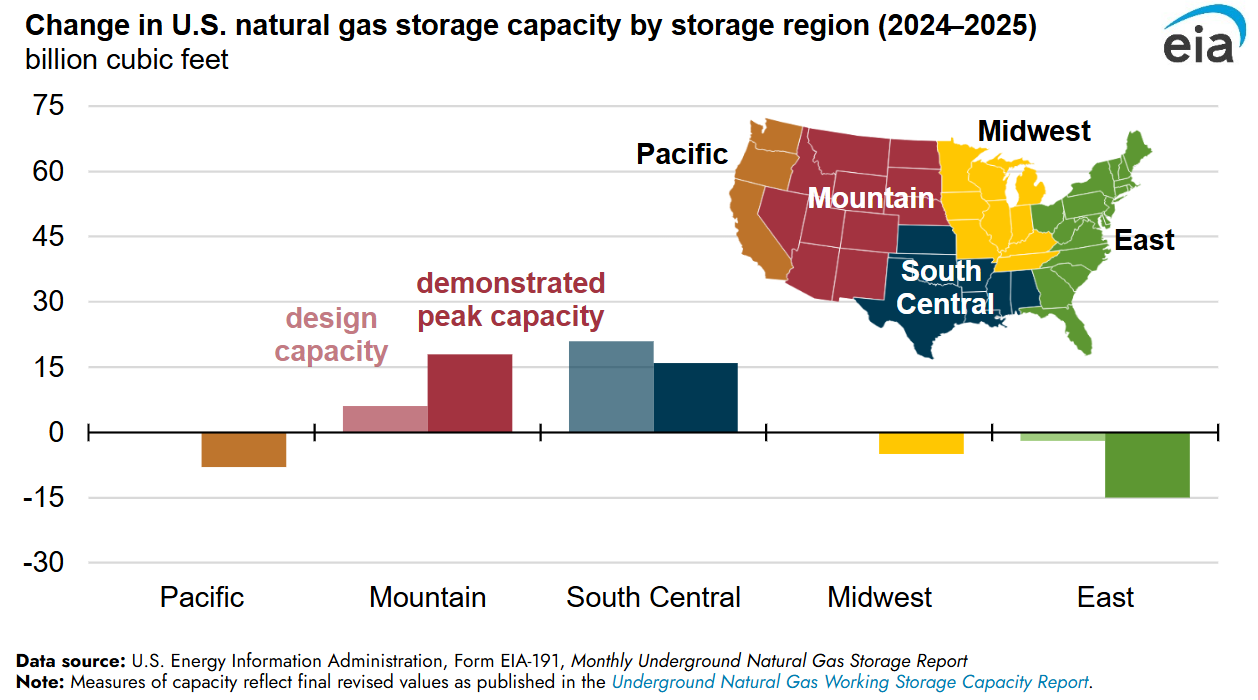
The EIA reported that demonstrated peak storage capacity — a measure based on the highest volume of gas stored in each facility during the previous five years — rose by 6 billion cubic feet (Bcf), or 0.1%, from 2024 levels. The increase marks the third consecutive year of growth as operators continue to maximize existing storage assets and add capacity at selected facilities.
The largest gains in demonstrated peak capacity occurred in the South Central and Mountain regions, which added 16 Bcf and 18 Bcf, respectively. Capacity declined in the East, Midwest and Pacific regions.
The agency also reported growth in working gas design capacity, often referred to as nameplate capacity. Total Lower 48 design capacity increased by 26 Bcf to 4,683 Bcf as of November 2025.
The South Central region accounted for most of the expansion, adding 21 Bcf of working gas design capacity, while the Mountain region added 6 Bcf. The East region posted a small decline due primarily to adjustments in base gas volumes, while capacity remained unchanged in the Midwest and Pacific regions.
Underground storage plays a critical role in balancing seasonal fluctuations in natural gas demand, providing supply during periods of elevated consumption and supporting overall reliability of the U.S. gas market.