
How Long Do Composite Pipeline Repairs Really Last?
CASEY WHALEN, CSNRI, Houston, Texas
Composite repair systems have been used for more than three decades to address integrity threats in oil and gas pipelines. Extensive laboratory testing, full-scale validation programs and field experience have shown that properly designed composite repairs can restore structural integrity and extend the service life of pipelines affected by corrosion, mechanical damage and certain crack-like anomalies.
However, because composites have been in transmission service for a relatively short period compared with typical pipeline lifespans, operators continue to ask an important question: How long do composite repairs actually last?
This article examines the durability of composite pipeline repairs through regulatory requirements, material characterization, full-scale testing and long-term field performance, with particular emphasis on failure mechanisms, long-term strength, fatigue behavior and the engineering criteria used to determine whether a composite repair can be considered permanent.
Pipeline operators increasingly rely on composite repairs as part of their integrity management programs. These systems provide a non-welded method of reinforcing damaged pipe, making them especially valuable where conventional repairs are difficult or hazardous to install. Challenging terrain, environmentally sensitive areas, restricted rights-of-way (ROW) and operational constraints can all limit the practicality of cut-and-replace or welded sleeve repairs. Composite systems offer a flexible alternative while allowing pipelines to remain in service.
As pipeline infrastructure ages, operators face increasingly complex integrity threats. Vintage manufacturing features, external corrosion, cyclic pressure loading, elevated operating temperatures and interactions between loading conditions all influence how defects initiate and grow. As a result, repair technologies must not only satisfy applicable codes but also demonstrate reliable long-term performance. Determining the lifespan of a composite repair therefore requires evaluating both the repair materials and the engineering framework governing their application.
Background and Definition of Permanence
Composite pipeline repairs first emerged during the late 1980s and became more widely accepted in the 1990s following industry-sponsored testing programs. Those early studies focused on determining whether composite reinforcement could be considered a permanent repair rather than a temporary mitigation method. The results ultimately influenced regulatory changes that allowed alternative repair technologies when supported by validated engineering analyses and testing.
Modern standards, including ASME PCC-2 and ISO 24817, take a performance-based approach. Rather than prescribing specific repair designs, they require evidence demonstrating that a repair system can maintain pipeline integrity throughout its expected service life under normal operating conditions. Within this framework, "permanent" does not imply indestructible; instead, it means the repair is expected to remain effective for at least the remaining service life of the pipeline when properly designed, installed and operated within established limits.
Material Behavior and Long-Term Performance
The service life of a composite repair begins with the characteristics of its constituent materials. Modern repair systems combine reinforcing fibers—typically fiberglass or carbon fiber—with epoxy or polyurethane resin systems to provide high tensile strength and stiffness. Long-term durability depends on resistance to creep, environmental degradation and maintaining adhesion between the composite and the steel pipe.
Long-term tensile testing plays an important role because composite materials can experience gradual strength reduction under sustained loading. Standards therefore require survival testing and, in some cases, extended qualification programs that evaluate strength as a function of stress, temperature and time. When repairs are designed so that operating stresses remain below validated thresholds, these degradation mechanisms are not activated, allowing the repair to retain its mechanical properties for decades.
Adhesion between the composite and the steel substrate is equally critical. Lap shear testing under dry, wet and elevated-temperature conditions verifies that the bond remains intact over time. Strong adhesion helps prevent moisture intrusion, minimizes the potential for corrosion beneath the repair and ensures effective load transfer from the steel pipe into the reinforcing fibers.
Full-Scale Testing and Validation
Material testing alone cannot establish repair longevity. Full-scale testing under representative operating conditions provides the clearest indication of how composite repairs perform under real-world loading.
Since the early 1990s, industry-funded programs and manufacturer-sponsored studies have evaluated composite repairs under burst pressure, cyclic fatigue, installation pressure, burial conditions and long-term environmental exposure (FIG. 1).
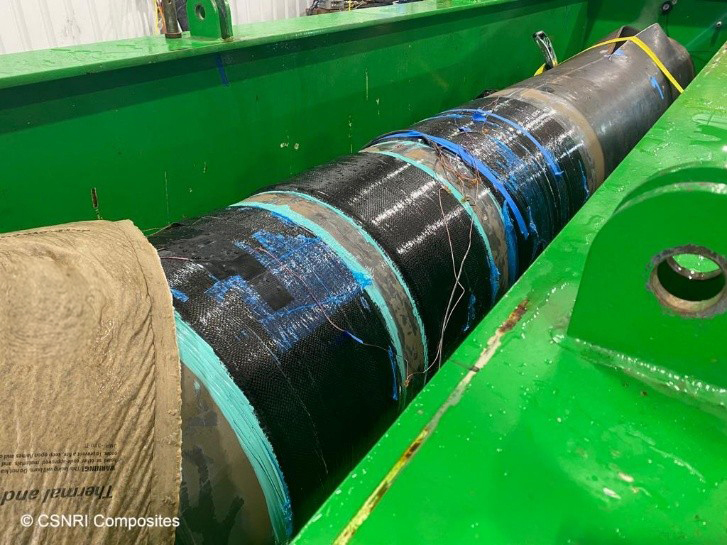
Testing has demonstrated that qualified composite systems can reliably reinforce metal-loss defects when properly designed. However, results also show that performance varies depending on system design and application. For defects subjected to high-cycle fatigue, installation pressure and composite stiffness significantly influence long-term performance. Certain high-modulus systems have demonstrated superior fatigue resistance, while others experience performance degradation when used outside their validated operating envelope.
Testing has expanded beyond corrosion repair to include dents, wrinkle bends and selected crack-like anomalies. In these applications, successful reinforcement depends on matching the composite's mechanical response to the dominant loading mode, whether hoop stress, axial stress or a combination of both. Repairs designed and validated with these loading conditions in mind are more likely to provide long-term service.
Engineering Design and Analysis
Engineering analysis bridges the gap between laboratory testing and field application.
For corrosion defects, standardized equations generally provide conservative repair sizing. More complex anomalies—including cracks and mechanically damaged regions subjected to high-cycle loading—require advanced fracture mechanics and composite mechanics analyses.
To achieve long-term performance, repair designs must incorporate appropriate safety factors while accounting for operating conditions, installation pressure and anticipated fatigue life. This includes evaluating the remaining fatigue life of the damaged pipe itself, since the composite changes the stress distribution within the pipe wall. In some cases, additional repair thickness may be required to extend asset life sufficiently for the repair to be considered permanent. Models validated through full-scale testing help engineers establish appropriate application limits and avoid deploying repairs beyond proven capabilities.
Evidence from Long-Term Field Performance
Although laboratory testing provides controlled evidence, field performance offers the strongest indication of repair longevity. Composite repairs installed during the 1990s have now remained in service for more than 25 yrs–30 yrs, providing valuable durability data (FIG. 2).
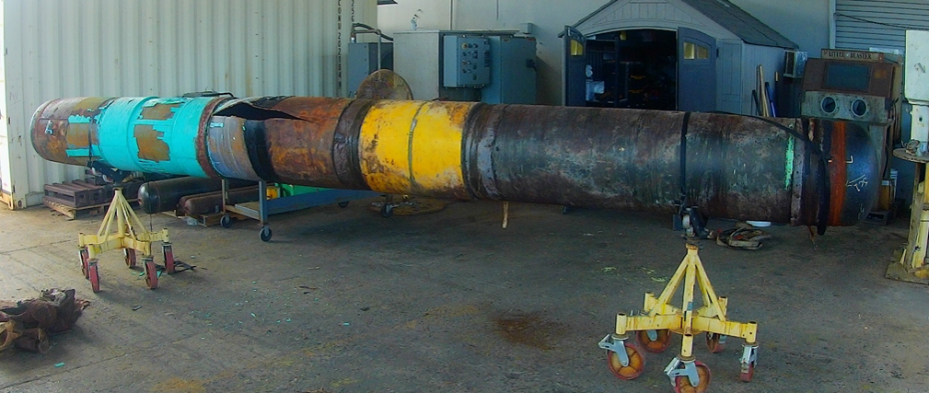
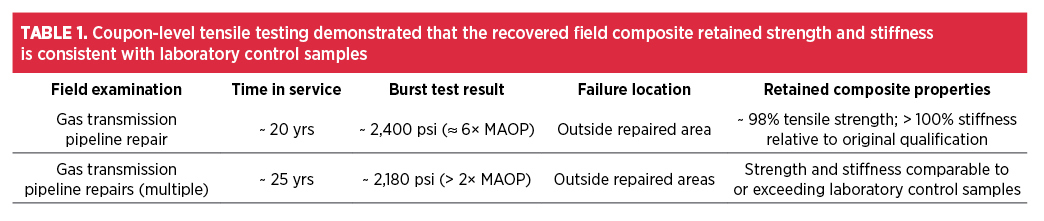
One destructive evaluation involved a composite repair installed on a 20-in. natural gas transmission pipeline that had remained buried for approximately 20 yrs. After excavation, the repaired section underwent cyclic pressure testing, hydrostatic burst testing and material characterization. The pipe successfully completed pressure cycling, and burst failure ultimately occurred in the unrepaired section outside the composite repair. Post-test evaluation found intact adhesion, no moisture intrusion and retained composite integrity. Tensile testing of recovered composite samples also showed mechanical properties comparable to the original qualification data, indicating minimal degradation after two decades of service (FIG. 3).
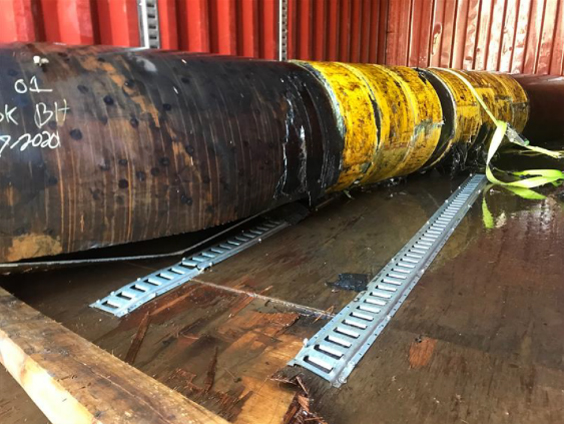
A second study evaluated a 24-in. gas transmission pipeline containing multiple composite repairs that had remained in continuous service for approximately 25 yrs. Hydrostatic burst testing again produced failure outside the repaired regions at pressures exceeding twice the pipeline's maximum allowable operating pressure (MAOP).
Coupon-level tensile testing found that recovered composite materials retained strength and stiffness comparable to—or slightly exceeding—laboratory control samples. Thermal testing likewise found no evidence of polymer degradation. Together, these findings demonstrate that properly designed composite repairs can maintain both structural and material performance over multiple decades (TABLE 1).
Implications for Integrity Management
Composite repairs offer an additional advantage by allowing continued inline inspection of the underlying pipeline. Operators can monitor anomaly growth over time and reevaluate repairs as operating conditions change. This supports a lifecycle-based approach to integrity management in which repairs are periodically assessed rather than assumed to remain static.
For operators considering composite repairs, long-term performance ultimately depends on selecting systems supported by comprehensive material characterization, rigorous full-scale testing and transparent engineering methodologies. Repair systems that simply satisfy minimum code requirements may not deliver the durability necessary for long-term service.
Conclusion
More than three decades of laboratory testing, full-scale validation and documented field performance support the long-term service life of composite pipeline repairs. Industry experience shows that when repairs are properly designed, installed and operated within validated limits, they retain structural integrity and bond strength for decades.
Field evaluations of repairs that have remained in service for 25 yrs–30 yrs demonstrate preserved material properties and effective load transfer without adversely affecting the underlying pipe. When combined with long-term sustained-load testing, fatigue testing and conservative engineering design practices, these results provide a strong technical basis for designing composite repairs with service lives of 50 yrs or longer.
For operators and regulators, this evidence supports treating qualified composite repairs as permanent repairs capable of lasting for the remaining service life of a pipeline. When applied in accordance with established standards, validated testing and defined application limits, composite repairs represent a durable integrity management solution rather than a temporary mitigation measure.
About the Author
CASEY WHALEN is Manager of Applications Engineering at CSNRI, specializing in composite repair solutions for pipeline infrastructure. His work focuses on extending asset life, restoring structural integrity and ensuring regulatory compliance through standards-based repair methodologies, performance validation and field application. Whalen regularly works with pipeline operators, inspectors and engineering teams to implement composite repair systems that improve pipeline safety, reliability and operational efficiency.