
What Does Data Center Growth Mean for Natural Gas Pipelines?
TYLER CAMPBELL, Editor-in-Chief, Pipeline & Gas Journal
(P&GJ) — The U.S. pipeline market seems to be entering a very different phase than many owners, operators and service providers have experienced for the past several years. As 2026 progresses, the market is not only about building more pipe but strengthening existing systems to meet demand. According to the International Energy Agency (IEA), global electricity generation to supply data centers is projected to grow from 460 terawatt hours (TWh) in 2024 to more than 1,000 TWh in 2030 and 1,300 TWh in 2035.¹
Coal is currently the largest share of global electricity demand, accounting for about 30% (mostly in China), followed by renewables at ~27% and natural gas at ~26%. Natural gas and coal combined are expected to meet more than 40% of the electricity demand needed from data centers until 2030 (FIG. 1).¹
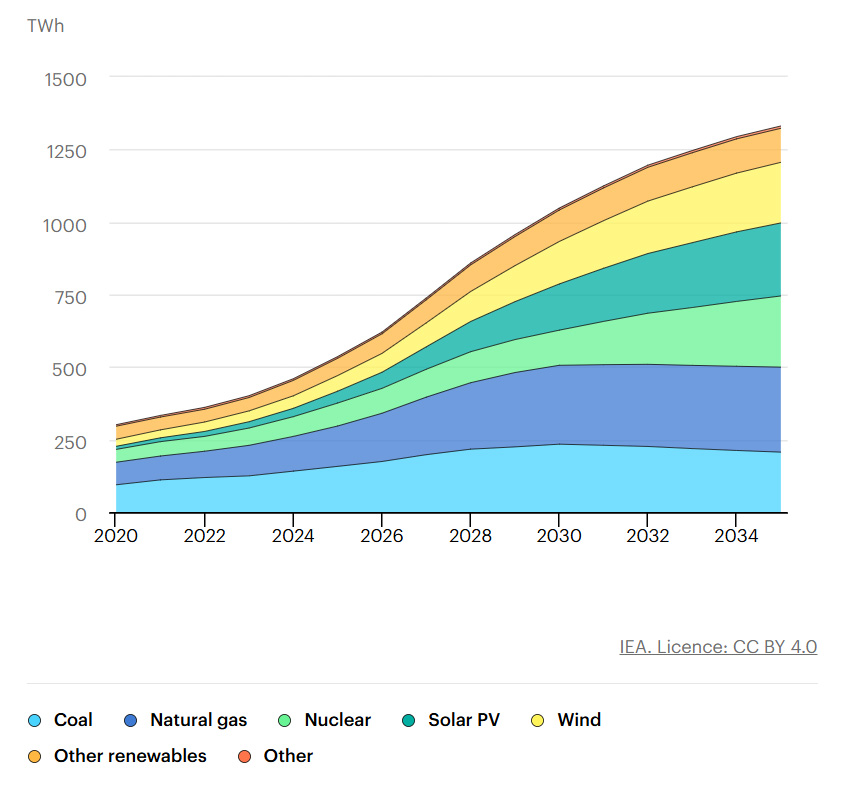
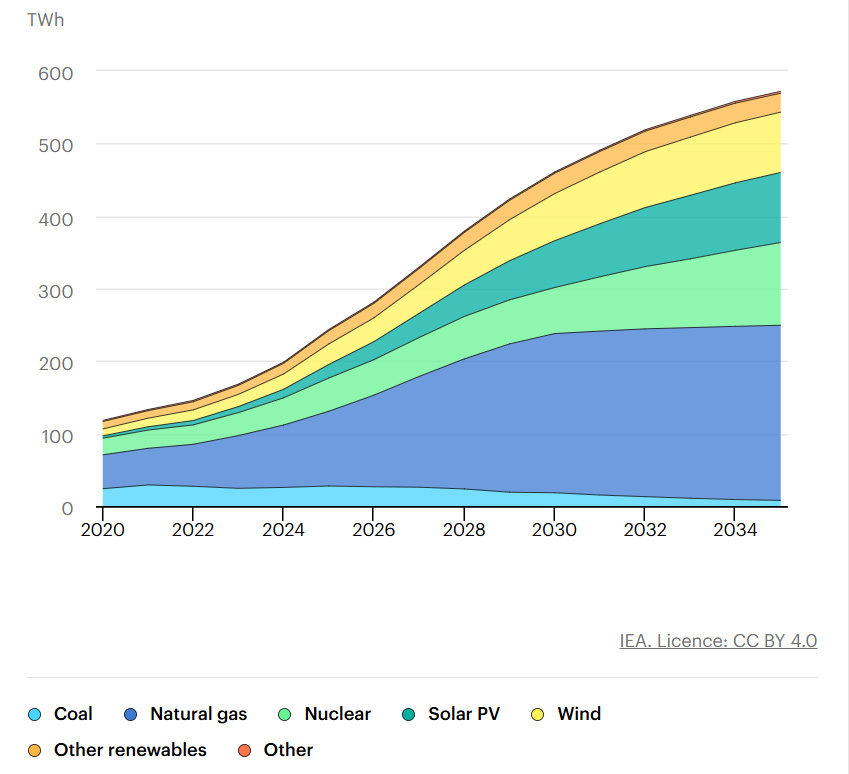
Today, the U.S. and China have the largest share of data centers globally. In the U.S., 40% of the electricity demand for data centers is met by natural gas, followed by renewables (24%) and nuclear (20%). Over the next 5 yrs, the IEA predicts that natural gas will continue to provide the majority of electricity demand for data centers, supplying more than 130 TWh/yr until 2030 (FIG. 2).
Artificial intelligence (AI), data centers and the broader energy transition have the potential to reshape how, where and why pipelines are being used. Global data center electricity demand is projected to roughly double by 2030, driven heavily by AI-optimized servers. These facilities increasingly cluster near reliable gas, power and fiber corridors, often coinciding with existing pipeline rights-of-way.
For example, Sapphire Technologies has partnered with Anax Power to deploy a system that converts pressure from natural gas pipelines into electricity and cooling for data centers. The approach co-locates modular data center infrastructure with existing pipeline assets, allowing operators to leverage existing energy flows while reducing the need for new transmission infrastructure.²
Under the agreement, Sapphire will provide its in-line turboexpander technology, which Anax will integrate into a co-located data center facility. The system captures excess pressure within natural gas pipelines and converts it into usable power and cooling without combustion, creating an additional energy source from infrastructure already in service.²
Another example is Energy Transfer—a natural gas gathering, compression, treating, transportation, storage and marketing services company, using nearly 107,000 mi of pipeline, 235 billion cubic feet (Bft³) of working storage capacity and more than 70 natural gas processing and treating facilities throughout the U.S. The company has reported requests from more than 40 prospective data centers in 10 states.³
Existing infrastructure
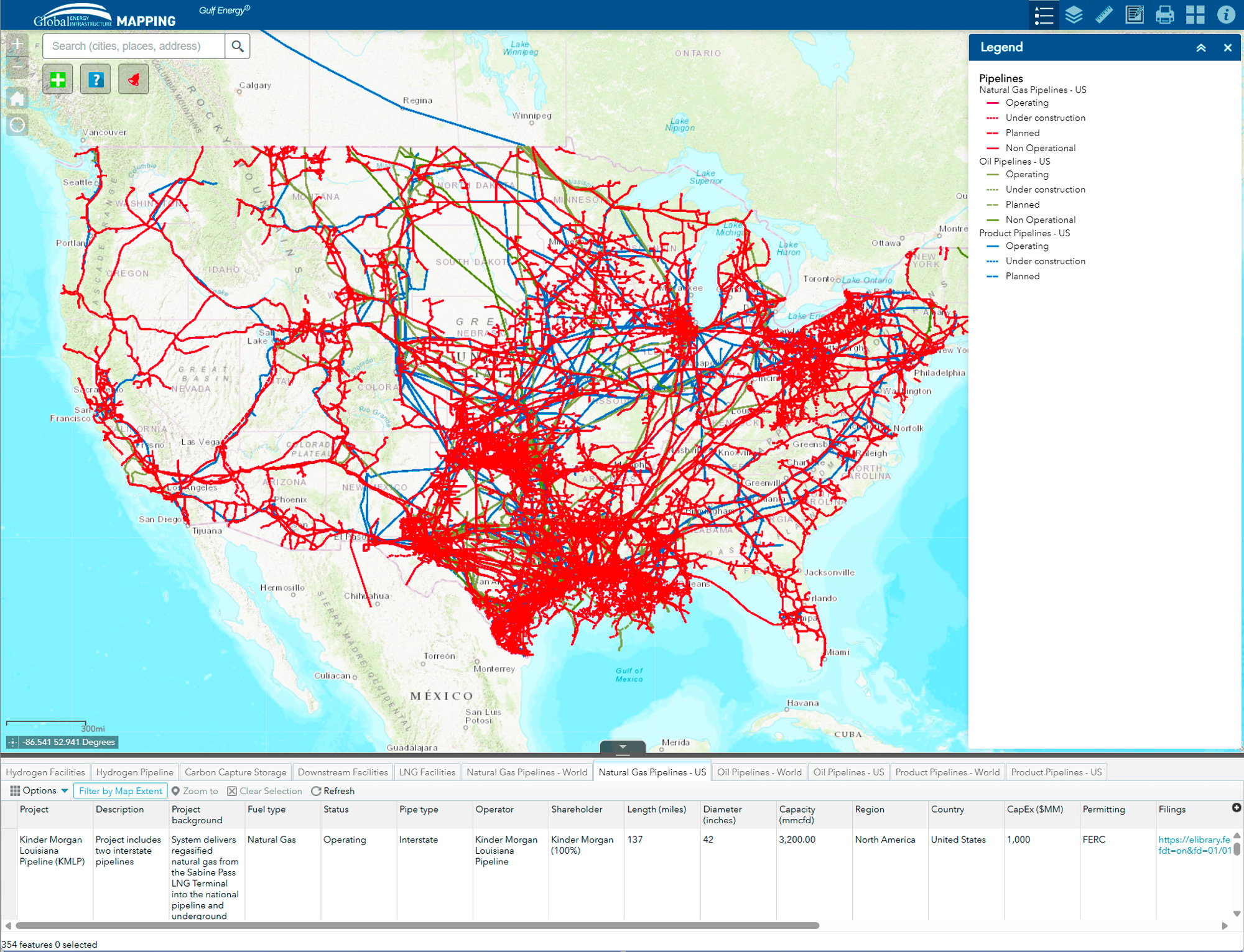
In the U.S., the majority of gas pipelines are already operating. Only a small number are under construction or firmly planned. Gulf Energy Information’s Global Energy Infrastructure (GEI) database is tracking 382 gas pipeline projects throughout the U.S., with 296 operating, 34 planned, 27 non-operational and 25 under construction.
Data centers are heavily dependent on the reliability of their fuel systems. Because of this, pipeline integrity will be critical, and reliability already seems to be a major consideration. The global pipeline integrity management market was estimated at just under $11 billion (B) in 2025 and is expected to approach $14 B by 2030. That is a compound annual growth rate (CAGR) of 27.27%.⁴
According to Pew Research, the U.S. has more than 3,000 operational data centers—this number is expected to grow exponentially. More than 1,500 data centers are in various stages of development throughout the country. Of these planned data centers, 67% are in rural areas and 33% are in urban areas, compared to 87% of the currently operating data centers being located in urban areas and only 13% in rural areas.⁵
Virginia has the most operating and planned data centers in the U.S. at 398, followed by Texas at 296. Virginia and Texas also have the most planned data centers, with 287 and 170, respectively. However, the state with the most planned projects is slightly different than the state with the most operating centers for the third slot. California has the third highest number of operating data centers (277), but Georgia has the third most planned data centers (141).⁵
In Virginia, Ashburn (133), Richmond (115) and Sterling (87) are the cities with the most operating data centers; in Texas, it is the Dallas-Fort Worth area (185), followed by San Antonio (71) and Austin (60); and in California, Santa Clara (68, and the heart of Silicon Valley), followed by Los Angeles (56) and San Jose (46).⁶
As you can see in Gulf Energy Information’s GEI Mapping, these areas all contain extensive pipeline networks (FIG. 3). These networks will likely be utilized to keep the data centers running and may have been a consideration during planning, as these centers depend on continuous operation.
However, reliability is only one part of the equation. Land and future expansion opportunities must be considered when selecting data center sites. According to a report from Jones Lang LaSalle (JLL), a global commercial real estate and investment management firm, Texas is projected to surpass Virginia in operating data centers by 2030.⁷ This is partly due simply to the greater availability of land in Texas.
Takeaway
As data center development increases across the U.S., existing pipeline assets will be necessary to keep them running efficiently. With the IEA’s prediction that global data center electricity consumption will more than double by 2030, industry experts believe that natural gas demand will grow in the coming years. At the same time, data center development continues to expand in states such as Virginia, Texas and Georgia, where both energy and transport infrastructure are well established. Whether supporting power generation or delivering fuel to growing demand centers, pipeline infrastructure is positioned to remain a critical component of the energy ecosystem.
Literature Cited
- International Energy Agency (IEA), “Energy and AI,” 2025, online: https://www.iea.org/reports/energy-and-ai
- Anax Power, "Sapphire Technologies partners with Anax Power to deploy integrated power and cooling system for distributed data centers," March 2026, online: https://www.anaxpower.com/sapphire-technologies-partners-with-anax-power-to-deploy-integrated-power-and-cooling-system-for-distributed-data-centers/
- Energy Transfer, "Energy Transfer poised for growth with rising demand for natural gas-powered data centers," January 2025, online: https://www.energytransferdatacenter.com/energy-transfer-poised-for-growth-with-rising-demand-for-natural-gas-powered-data-centers/
- Mordor Intelligence, “Pipeline integrity management market size & share analysis—Growth trends and forecast (2026–2031),” 2026, online: https://www.mordorintelligence.com/industry-reports/pipeline-integrity-management-market
- Pew Research Center, “Most new data centers in the U.S. are coming to rural areas,” April 2026, online: https://www.pewresearch.org/short-reads/2026/04/13/most-new-data-centers-in-the-us-are-coming-to-rural-areas/
- Data Center Map, “Data centers,” online: https://www.datacentermap.com/datacenters/
- JLL, “Data center sector enters hyperdrive as Texas prepares to dethrone Virginia as global leader,” February 2026, online: https://www.jll.com/en-us/newsroom/jll-north-america-data-center-report-year-end-2025